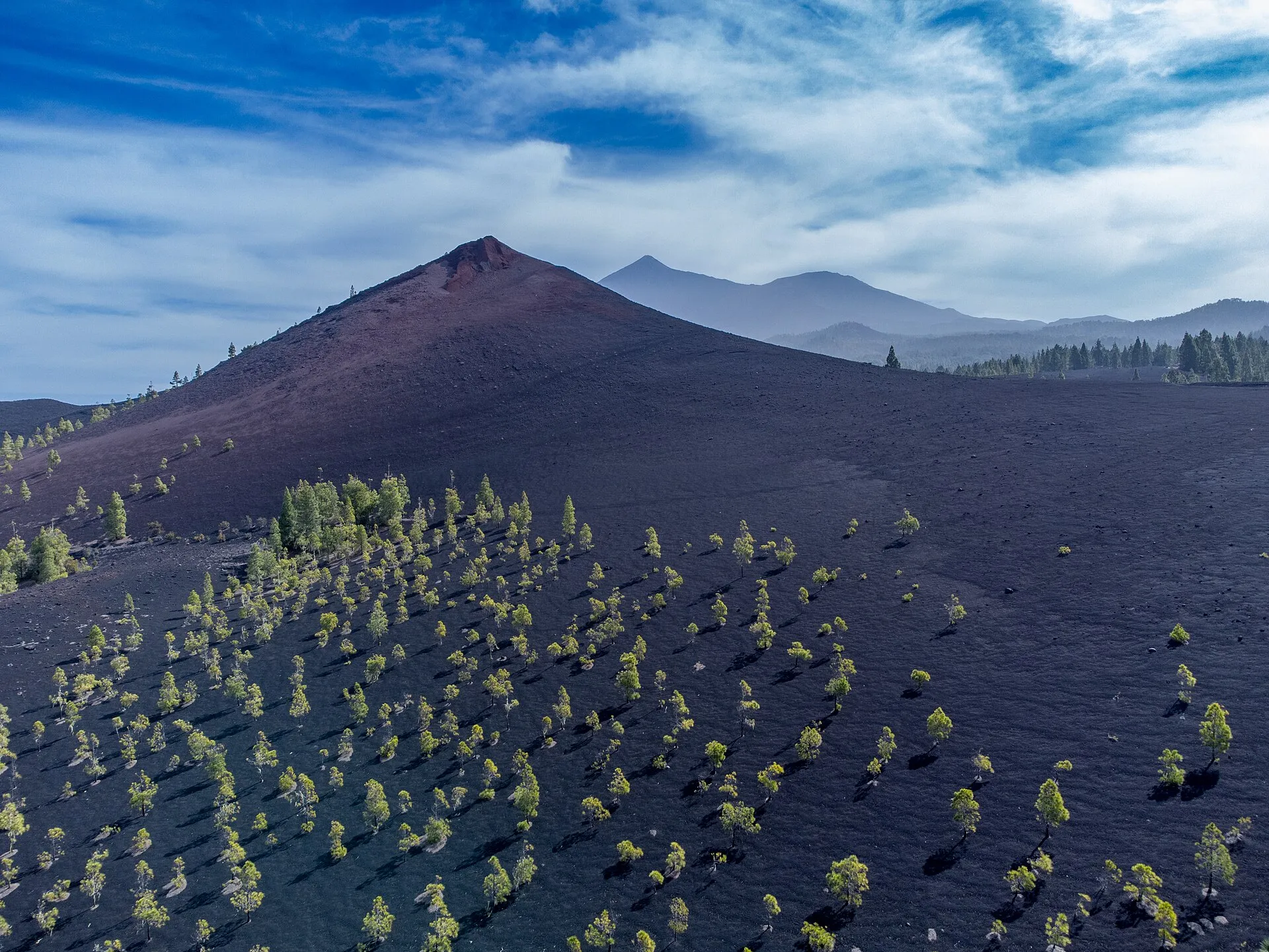
Chinyero is where Tenerife last erupted. Between 18 and 27 November 1909 the vent opened on the western slopes above Santiago del Teide and poured lava for about ten days. More than a century later the flows are still bare black rock, with pine forest slowly growing back into them — and the trail walks straight through it.
Why this one is different
Most volcanic landscape on Tenerife is ancient enough to have weathered into soil. Chinyero has not. The lava is recognisably lava: sharp, glassy, piled in ridges, and almost unvegetated except where Canary pines have found a foothold.
The Canary pine is worth knowing about here, because it is the reason the scene looks the way it does. It is one of the few trees in the world that survives fire and can regenerate from a scorched trunk, which is exactly why green trees are standing in a field of black rock rather than the other way round.
What the walk involves
Allow around two and a half hours at a moderate pace. The reserve is protected and the trails are marked; the branch most walkers use starts from Santiago del Teide.
The difficulty is underfoot rather than uphill. Volcanic rock is abrasive and uneven, and it eats thin soles. Wear proper shoes.
The easier alternative
If two and a half hours is too much — with children, or late in the day — Arenas Negras covers similar country in about half the time. Our hosts recommend it explicitly as the shorter option, and the landscape is not meaningfully less impressive.
Getting there
Around forty-five minutes by car from the apartment, climbing away from the coast towards Santiago del Teide. Take layers: you gain a lot of height, and weather up here is not the weather you left at sea level.